Tutorial: Square Packing from First Principles
- Human oversight: Levy
- Agents: Opus 5, Fable 5, Fable 5.1, Opus 5.5, and GPT-6 Astra
- First published October 1, 2026 · Last revised October 15, 2026
How small a square can hold eleven unit squares? A grid leaves five spaces empty. Rotating some of the squares gives a packing with side about , and a matching lower-bound proof establishes that no smaller square works. Finding the arrangement and proving that it is best are different problems.
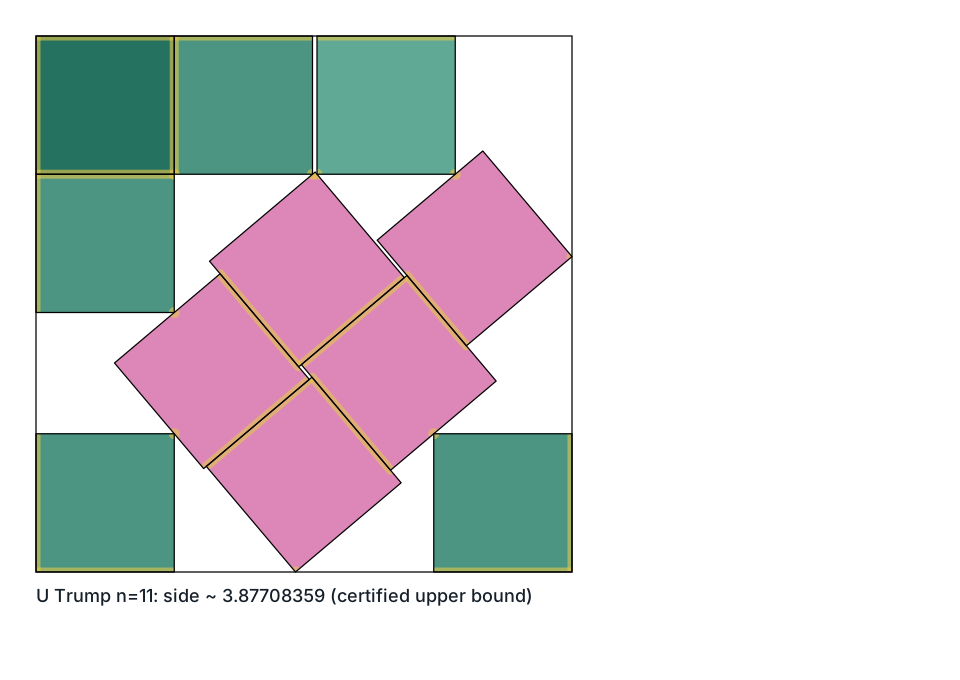
Trump’s 1979 construction: six squares are axis-aligned and five share an
oblique tilt of about 40.18°. Ahmed’s 2026 proof establishes its optimality; the
repository records the complete machine checks at V3/C3 in
T-060.
The drawing shows the construction; the proof excludes every smaller container.
Segments mark shared edge intervals; dots mark point contacts.
They are computed in the exact number field and clipped to the participating squares.
This basic tutorial develops the geometry and the distinctions needed to read a packing result. The advanced tutorial develops linear programming, exact arithmetic, search, regularization, and computer-assisted proofs. Result statuses below were checked against the repository’s register on 14 October 2026; the case records hold the maintained bounds.
1. The Problem
A unit square has side length one. We place of them inside a larger square. Each may translate and rotate independently. They may touch along edges or at corners, but their interiors must be disjoint: no positive-area overlap is allowed. Every point of every small square must lie in the container, whose boundary is also allowed to touch them.
The number is the smallest container side that permits such a packing. The minimum is attained: there is a best packing, even when we do not know it. One way to see why is to take progressively smaller feasible containers and use the bounded positions and angles to extract a convergent subsequence. Containment and non-overlap survive the limit. The compactness background is discussed in Martin’s work, listed with the mathematical references.
A pose specifies one square’s center and angle. A configuration specifies the poses of all squares and the container side. A feasible configuration, or packing, satisfies containment and non-overlap. These definitions separate something a search program can propose from something that has been checked to fit.
If the small squares had side instead of one, multiplying every coordinate by would multiply the answer by . Fixing the small side at one removes that irrelevant choice of scale.
2. Bounds and Small Examples
An upper bound means : some packing fits at side . A construction proves such a bound once its geometry has been verified. A lower bound means : every feasible container has side at least . It must account for arrangements we have never found, with every permitted rotation. When a verified construction and a lower-bound proof meet at the same value, they prove global optimality.
Two bounds require almost no geometry.
- Area: the small squares have total area , so a container of area needs . Therefore .
- Grid: a square grid with rows and columns has room for unit squares. Removing the unused ones gives .
Thus
For , the two sides agree: . For eleven squares they give only , leaving substantial room for better geometry.
| Number of squares | Optimal side | What the example teaches |
|---|---|---|
| 1 | One square fills its container | |
| 2 or 3 | Area alone need not give the answer; these classical lower bounds require geometry | |
| 4 | The area and grid bounds meet | |
| 5 | A tilted construction improves on the side-3 grid | |
| 9 | Another exact grid case | |
| 10 | A tilted construction improves on the side-4 grid |
The three-square, five-square, and ten-square records give the proofs and constructions. Göbel supplied the five- and ten-square constructions; Stromquist supplied the lower-bound proof for ten. The decimal approximations in the table help compare sizes; the expressions with specify the exact values.
There is another useful comparison rule: . Removing a square from any packing of produces a packing of at the same side. Consequently a verified upper bound at a larger count may already imply a proposed upper bound at a smaller one. The register’s T-156 is an example: its bound for 290 squares follows from an existing certificate for 291.
3. Why Rotation and Contact Matter
Rotation changes how a square uses horizontal and vertical space. An axis-aligned unit square spans one unit in each direction. At it spans in each, so rotating a square makes its bounding box larger. The improvement comes from how several squares fit around one another, rather than from a tilted square becoming smaller.
At eleven squares, restricting every orientation to or gives a lower bound of , by Stromquist’s restricted-orientation theorem. Trump’s packing fits below that side, at , so those two orientation classes cannot contain an optimum. Its five tilted squares use an angle near instead. The eleven-square case records the restricted theorem and the unrestricted result separately.
A drawing can make two edges look touching when a tiny gap or overlap separates them. A contact is an exact geometric equality: two square boundaries meet, or a square meets a container wall. For Trump’s exact construction, 14 of the 55 pairs touch. Checking all contacts and all remaining separations is part of proving the construction valid.
A jammed backbone is a contact-constrained subset that cannot move collectively in the declared setting. Other squares may still move without changing the side. A rattler has room to move inside a cage formed by the other squares and the container; a slider moves along a permitted family of positions. Such motion does not disprove optimality, because the container need not become smaller.
For example, three axis-aligned unit squares with centers
all fit in a side-2 container. The top square can slide across the two bottom squares. Every value of gives an optimal packing because . Changing coordinates therefore need not discover a genuinely different optimal family. The advanced tutorial explains how relabeling squares, rotating or reflecting the container, and continuous motion affect the objects a search should count.
Rigidity, uniqueness, and optimality ask different questions. Rigidity rules out local motion in a declared setting. Uniqueness says all optimal packings are the same after specified symmetries. Optimality says none fits in a smaller container. Each requires its own argument.
4. What a Computer Can Establish
A numerical search chooses centers and angles, measures overlaps or separation, and adjusts the configuration to improve the container side. It explores only some of the possible arrangements. A run that finds nothing better supplies a search result, not a lower-bound proof.
Refinement improves a candidate near where it already lies. A local minimum cannot be improved by a sufficiently small feasible change, while a global minimum is best among all feasible configurations. Even proving the first does not prove the second. The advanced tutorial separates refinement from exploration and explains how fixed-angle linear programs make part of the search tractable.
Numerical and exact coordinates
Floating-point numbers have finite precision. A program may treat a tiny negative clearance as zero within a tolerance, a stated allowance for numerical error. That can help locate a promising packing, but an overlap smaller than the tolerance is still an overlap. Printing a hundred digits does not establish that those digits represent a valid construction.
An exact certificate instead specifies data and checks that decide the claim without such an allowance. Rational coordinates use fractions of integers. Algebraic coordinates can specify a root of a polynomial, distinguish it from the polynomial’s other roots, and express the remaining coordinates in terms of that root. Then a checker can decide whether a contact is exactly zero and whether every other clearance has the correct sign.
The advanced tutorial explains how typed contacts and stationary branches support exact reconstruction from numerical candidates.
Rigorous interval arithmetic offers another route: it encloses the true answer, including rounding error. If an entire clearance interval is positive, separation is proved. An interval that straddles zero leaves that test unresolved; it does not prove a contact. Certified equations can establish exact contacts, but ordinary approximate residuals cannot.
There are accordingly two different uses of “exact”:
- An exact construction proves feasibility at its stated side, hence an upper bound.
- An exact value of also requires a lower-bound argument excluding every smaller side.
A rational construction may sit slightly above a suspected algebraic optimum. Its certificate can be completely exact while its bound remains weaker than the optimum.
What the status labels mean
The project records the statement being checked separately from the strength of its evidence. For an individual evidence entry:
| Label | What has been established |
|---|---|
reported |
A named source states the claim |
numerically-checked |
A finite computation checked specified predicates at recorded precision and tolerance |
verified |
An exact check, rigorous certificate, or proof establishes the stated claim and its premises |
Whole results use two further scales.
Verification (V) describes the verification supported by the source packet;
confirmation (C) describes what a party beyond the producing run has established.
A source’s proof and this project’s replay are separate facts.
At V3/C3, the result has checkable support and the confirmation meets the
corresponding rung. Higher rungs require specified reviews and human oversight; formal
source code alone does not earn them.
Significance (S) rates importance, and novelty (N) records the supported
origin or novelty assessment.
An S5 result can still be V0/C1: important enough to follow, but only reported and
read here. Neither significance nor a large number of printed digits proves the
mathematics. Epistemics defines the complete scales and the evidence
each requires.
Even two passing checkers may share a parser, arithmetic library, or interpretation of the claim. The record therefore states whether confirmation reproduced the producer’s code, reimplemented it with shared components, or used an independent implementation, and whether the check covered the whole claim or a sample.
5. Reading the Current Results
Eleven squares illustrate how the evidence fits together.
Trump’s exact construction proves an upper bound.
Ahmed’s proof supplies the matching lower bound, after a complete finite cover of
possible arrangements, exact exclusions, and a local argument around the surviving
configuration. The repository records the equality as
T-060, V3/C3. Its checks share some arithmetic and construction components with
the source; this is documented confirmation, with its degree of independence stated.
Uniqueness is recorded separately as T-112, V3/C2: every optimum is Trump’s
packing up to container symmetry and relabeling.
Its additional equality-case argument has a different confirmation status from the
bound. A Lean formalization of the value has also been reported, but the complete build
and expert-review requirements for raising its formal-verification rung have not been
met in the retained record.
These distinctions are in the results register.
At seventeen squares the register keeps a different boundary.
Overbeck’s candidate optimality proof (T-153) and Fitzharding’s
separate Lean formalization (T-154) both concern Bidwell’s side, approximately
. Both remain V0/C1, despite their S5 significance.
Reviews and partial checks are retained, but the complete replays needed for
confirmation are outstanding.
The seventeen-square case therefore distinguishes its
reported status from its verified status, which remains open.
Its verified bracket is
The right side is about . It is a verified rational upper bound; that does not turn the reported equality into a confirmed one.
Many recent improvements concern larger constructions rather than optimality. For example, Ostashev’s T-158 supplies exact rational certificates for 175, 232, and 264 squares. Each proves its stated upper bound. None supplies a matching lower bound. The source packet credits the constructions and the earlier pieces they build on.
Two quantities help avoid misreading progress:
- The bound gap is the distance between the verified upper and lower bounds. It is zero at eleven and remains positive in the verified seventeen-square record.
- A search gap compares one run’s best side with a named standing best. A run can remain far from the optimum even after somebody else has proved its value.
A new report, an accepted intake review, and an adopted bound are also different steps. The 14 October intake ledger compares reported sides; it does not verify their certificates. Only the case records establish which bounds the project has adopted.
6. Reading a Packing Picture
The atlas shows geometry alongside evidence and attribution. A displayed square may come from a numerical source witness or from an exact certificate. The accompanying record tells you which, what side was checked, and who supplied the arrangement. Pixels alone establish none of those facts.
A regularized view makes an existing arrangement easier to read: it may straighten near-axis squares, close contacts, or align sub-blocks. The source witness is retained. Under the regularization policy, the drawing keeps the source record’s evidence tier and credit; an exact redraw does not silently upgrade either. If the process produces a certificate below the case’s verified upper bound, that certificate takes a separate result-registration path. The advanced tutorial explains the checks and side comparisons.
A useful way to inspect any claimed improvement is to identify the exact statement: which , which side, and whether it concerns a construction, a lower bound, rigidity, or global optimality. Then follow its evidence link. A claim about one packing is often much easier to establish than a claim about every possible packing.
7. Further Reading
| To explore | Read |
|---|---|
| Linear programs, exact arithmetic, search and proofs | Advanced Tutorial: Square Packing, Search, and Proof |
| Current bounds, sources and witnesses for each size | The frontier |
| How historical record packings were found | How Record Square Packings Are Found |
| The complete eleven-square argument | Eleven-Square Optimality |
| Evidence grades, confirmation and credit | Epistemics |
| The program, tools and retained research | Synopsis and development guide |